Case Study & Guide: Fixing Next.js Crawl Traps in Replit to Scale Search Impressions 35x
Real estate brokerages and dynamic listing sites live or die by search indexation. When hosting a Next.js 15 (Pages Router) application on Replit, getting pages built is fast—but ensuring Googlebot indexes thousands of dynamic listings requires strict crawl management.
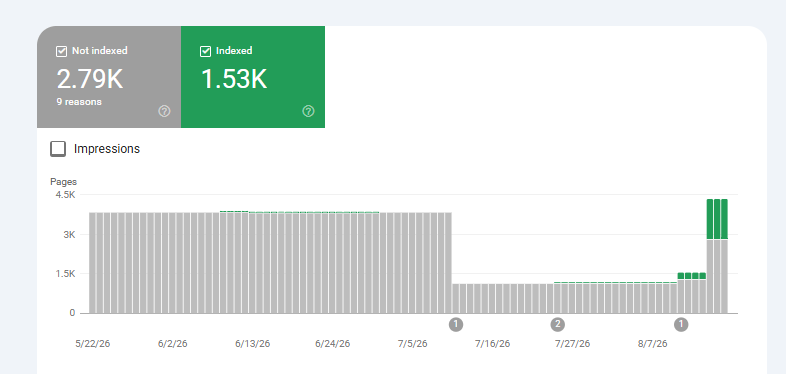
After intentionally pruning a real estate platform from 3,800 down to 1,200 core URLs, Google Search Console (GSC) indexing stalled at just 287 pages, leaving 2.79K URLs unindexed. Daily search impressions hovered at a stagnant ~100 per day.
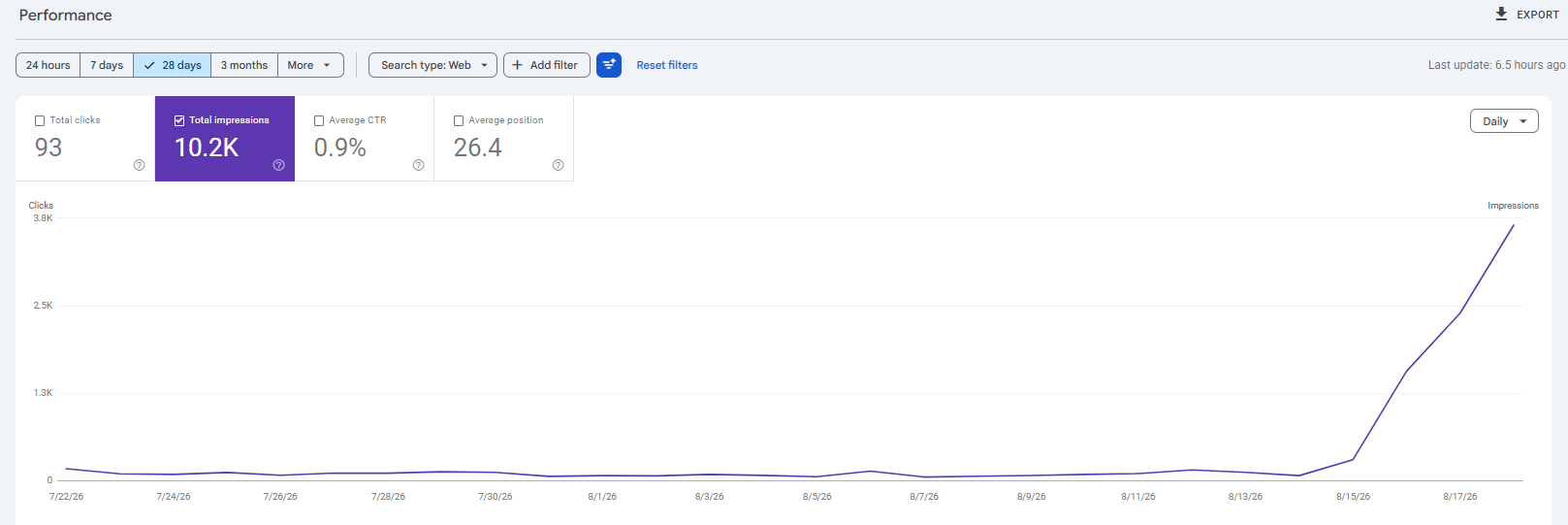
Within 7 days of deploying four targeted fixes in Replit, Search Console reported a dramatic breakthrough:
-
Indexed Pages: Increased 5.3x from 287 to 1,530+ (1.53K).
-
7-Day Total Impressions: Reached 8.26K total impressions.
-
Daily Impression Spike: Surged from ~100 to 3,800+ impressions/day (August 18).
Here is the step-by-step diagnostic workflow and the exact Replit prompts used to achieve these results.
Step 1: Diagnose the Crawl Bottlenecks
Before prompting Replit, run a site crawl (e.g., Screaming Frog) alongside GSC exports to isolate the exact structural failures:
-
Soft 404 Loops: Deleted pages returned standard Next.js
return { notFound: true }responses (404s). Googlebot treated these as temporary breakages and kept retrying old URLs. -
Orphaned Listing Pages: 102 core pages (46% of the site) had only 1 unique internal link, making them look like low-value orphan content to search crawlers.
-
Canonical Parameter Waste: UI dropdowns generated crawlable links like
/off-plan?developer=emaar, forcing Googlebot to evaluate 31 duplicate parameter variations. -
Image Payload Latency: Next.js
<Image/>components requested3840pxdevice sizes for small grid thumbnails, pushing Server-Side Rendering (SSR) latency up to 2.26 seconds.
Step 2: Implement True HTTP 410 Signals in Replit
To stop crawlers from wasting time on pruned listings, signal permanent removal using HTTP 410 Gone rather than 404 Not Found.
Replit Prompt:
"Update our Next.js routing and middleware. For pruned or deleted records (such as old off-plan project slugs or invalid developer paths), configure the app to return an explicit HTTP 410 Gone status code via res.statusCode = 410 in getServerSideProps or intercept them in middleware.ts. This instructs search crawlers to permanently purge those URLs rather than continuously re-testing them."
Step 3: Eliminate Link Isolation with Relational Grids
Googlebot discovers and ranks pages based on internal link depth. Connect your listing templates using database foreign keys (developer_id, community_id).
Replit Prompt:
"Inspect our database schema and Next.js page templates. Update our dynamic templates so that:
Every
/developers/[slug]page renders aDeveloperProjectsGridcomponent fetching all matching off-plan listings via database foreign keys.Every
/off-plan/[id]listing page includes a sidebar linking back to its parent developer, parent community, and 4 related sibling properties in the same area.The global footer component includes a static grid linking to our top 12 primary developer landing pages to ensure baseline internal link depth across the entire site."
Step 4: Shield Crawlers from Parameter Loops
Convert UI filter dropdowns to client-side state so crawlers don't discover duplicate parameter paths.
Replit Prompt:
"Inspect our frontend filter components on
/off-planand/properties. Refactor them so that selecting a filter updates the view via client-side Next.js router state or buttons, rather than rendering crawlable parameter links in the DOM. Additionally, updatepublic/robots.txtto explicitly disallow parameter crawling:
> User-agent: *
> Disallow: /off-plan?*
> Disallow: /properties?*
>
Step 5: Cap Device Sizes & Auto-Compress Images
High Server-Side Rendering (SSR) Time-to-First-Byte (TTFB) causes search engines to abort or defer crawling. Restrict device widths in next.config.js and enforce server-side image compression.
Replit Prompt:
"Update
next.config.jsto restrictdeviceSizesto[640, 750, 1080, 1200, 1920](removing 2048px and 3840px). Next, installsharpand update our image API route / upload pipeline so that stored assets are automatically capped at a maximum width of 1920px and compressed at 75% quality WebP encoding."
Verified Search Console Results
-
Indexed Pages: Scaled from 287 pages to 1,530+ pages (+433% growth)
-
Unindexed Page Backlog: Reduced from ~3.8K pages down to 2.79K pages (-26.5%)
-
Daily Impressions Peak: Surged from ~100/day to 3,800+/day (+3,700% growth)
-
7-Day Total Impressions: Increased from under 800 to 8.26K total (~10x growth)
Fixing Next.js technical SEO in Replit comes down to clear engineering signals: emit accurate HTTP status codes, keep internal link depth under 3 clicks, shield parameters, and keep SSR payloads light.